Tuesday, 21 January 2020

Citadel - Series 2

There were eventually four sets of books bound for The New Alexandrian Library and book 2 begins a new chapter in the Citadel Series.  All this information will be included on the article on David, but it is here for my own reference! These are very precious books to me.


Citadel II/1 is dated 9/5/2017 and II/31 9/12/2017.

This series concluded the words included in the Cyberwit publication of The Citadel. 
II/1 
has a thematic development with many references to war and death, weapons and Ani, evil in history with the inquisition, urban references with blinking neon, references with deep space, atomic fusion, helium arc. The metaphysical – transmigrations, psyches, ruach.

Ruach – a Hebrew word meaning breath or spirit – and so David breathes the traces of his worlds into our own consciousness.  

Jasmine appears again in the concluding poem:

Jasmine’s pitch
arraigned in gravel
and ice evening sounds
elliptical bends
weapon groves the
Rosenbergs executed
By our poor time…

He is coupled with the Rosenberg’s, atomic spies who were executed in the 1950’s, smoking jackets with elbow patches who represent academics and Hobbes: a traveler representing David’s own self-reflexivity, where the structure of his words indicates his own concerns

Citadel III/1 – III/39
Citadel III marks the  beginning of The Citadel 2 published by Cyberwit.  Citadel III/1 is dated 16/12/2017.  This book concludes with III/39 dated 28/11/2018. That’s many months of writing and honing in on leitmotifs so varied they become their own theme. 

Notes for III/1:
                  
Lake Shore Drive – very expensive real estate along Lake Michigan shoreline stretching along the city of Chicago and its wealthy suburbs. 
Mines – reference to Kingston Mines
Haymarket (a frequent occurrence in David’s work) – Chicago labor riots in 19th century.
Drawbridges - many of them in downtown Chicago over the Chicago River.
Liftraft – wade upwards
Green River – Chicago River (old Mayor Daley the First dyed the river green on St Patrick’s Day)
Now this was a strange tradition I had never heard of – but it made for interesting reading. In spite of a poetic set very structurally in Chicago (Lake Shore Drive/Haymarket/Kingston Mines/drawbridges/Chicago River/Kemper Building, in Stone-ian style we are forced to touch base with Charlemagne and Mars Station (referencing the second simulated Mars analogue habitat owned and operated by the Mars Society?), tied together with the Chicago skyline by “dizzy tranquil threads”. 

III/39 notes – a sombre set of words, this, where on is left contemplating

A pint of blood
one wonders
an account
of a soul.

Notes:
Travellers – thinking of road travellers, the Honduran migrants flooding the US and,  ‘traveler’ as a term relating to ‘commonism’ (I’m not certain what that reference is).
Creaking door – thinking of a gate to an alley
Mortician on the battlefield….coffee percolating… - the jump from life to death
Game of roulette – element of chance in the drama

                  The mortician
                  surveys the battlefield.
                  there are no
                  blessings. 
                  Choked forms 
enter the cold
realm.

Mary Barnet gives a very excellent review of David’s Citadel poems where she describes him as a Surrealist n the school of Salvador Dali. I’m not certain I agree with that categorization although there are many similarities in terms of the subconscious interacting with sensory representations.  And of course, let’s not forget the role of chance in the juxtapositions of thoughts and words.  

Citadel III/41 – IV/31
The fourth book in the Citadel Series comprising typed poetry and accompanying hand written notes. Citadel III/41 is dated 23/12/2018.

Citadel III/41 uses recurring references to Gettysburg. There are images of the memorial battlefield in Pennsylvania, haunting word representations of thousands of Union and Rebel troops with 19th Century muskets firing and killing – so much dying.  The fields are filled with bloody soldiers dying in the grass.  The trees are smoking - nature too, wounded by the travesties men impose violently on men.   There is another reference to the North Sea.  This time David said he used this ectype to depict Guido’s (Vermeulen – Belgium)  exit and Jasmine, now ‘plays irradiated tons on the piano at the bar’.  This mental nudge to David’s alter ego is perhaps situated right there for us to realise that the filter David sees the world through is veiled through the mediation of another.  The alter ego intervenes on behalf of the vulnerable poet in order to shield him from first hand horror. 
                  
Citadel IV/31 concludes this series (so far) and finished the publication The Citadel 2. Jasmine is here in full force, recounting a very abbreviated 70 year history which includes the Cold war of the 50’s, the radical 60’s, the ‘normalization’ of the 70’s, to the present. 

David was in Israel in 1970 – 1971. Jasmine and David entwine, boon mental companions enjoying Jasmine’s “symphonic compositions”, while David in first person tells us:

                  In Israel above the wailing 
wall at night, the Old City of
Jerusalem floats like a gigantic,
bright full moon that seems
so close I could touch  it by 
standing n a ladder and I
thought that God was hiding
on the other side of the moon.

Wednesday, 15 January 2020

David Stone - Citadel 20 - 67

Citadel 20 – 67
This collection of poems, accompanied by hand written notes by David Stone, represents poetry in The Citadel series which would eventually find its way to the publishing house of Cyberwit. The first 19 Citadel poems were bound as two envelope books for An Encyclopedia of Everything in the "Undo to Read" series.  Citadel 20 is dated 15/11/2015 and Citadel 67 is dated 27/4/2017. 

I am very grateful to have observed, in a small way, David’s journey in this series.  His words inspired artworks which became a win-win for both of us and his yellow post-its encouraged.  This collection was bound in December 2019 while working on a paper of David's book works in my collection. These poems are not for the faint hearted, nor the casual reader. David’s invitation to engage is open, but also guarded, loaded with LIFE. 

Friday, 3 January 2020

Envelopes 2 And Things

Unique Book, commercial wire binding comprising the envelopes of John Bennett (USA).  Some of his sendings are interspersed between the opened envelopes (including the days of swopping shopping lists...).  Other envelopes are partially opened to form pockets for his TLP's.  Book 2 in the series.

This book was inspired by Karl Friederick Hackers work MA Book Object - Edition Footura black – see: http://newalexandrianlibrary.blogspot.com/2019/10/ma-bookobject-edition-footura-black.html


Karl had opened some of his mail art envelopes, saddle stitched them in a cardboard cover and posted them to me as a Book Object. But, if I was going to use these envelopes to make a second envelope book, what would become of all the work sent? So I bound it all together – and SO happy it is.   John makes good use of his envelopes, using them as a whiteboard on which to scribble/stamp/draw some of his current ideas. 

So! Back to the history of envelopes…
Around 200BC, the Chinese developed the first envelope made from paper. But rather than messages, these simple protective wraps were used to send monetary gifts. At around the same time, wealthy Japanese men used early versions to send gifts to relatives after a death. Both the Chinese and Japanese versions at the time were believed to be rather crudely made by hand. For more information, you’ll have to read the book…


Monday, 16 December 2019

Leopard Jasmine

From the safety of a comfortable chair, one can travel the world of Professor Leopard Jasmine, a character who can change his spots. In fact, David Stone has given his alter ego the opportunity to traverse anywhere David is willing to take us in his Word World. Leaving the Oriental Institute at the University of Chicago AND his wife and children, Jasmine embarks on a journey to  ‘find himself”. As time and later works expose, Jasmine will continue to wander in poetic flow through David’s words.  Here he is  a traveller/composer in this, David’s first book length poem,  then he is a magic user who visits Atlantis in his play Magus Jasmine, and later  a temporary, but continuous tenant in later works. In Leopard Jasmine, Jasmine incantates sym-phonetic notes whilst traversing the stars, Olympus, the Sahara, Iowa and everything in between.  Each of his destinations are compressed in time and space to appear in solar orbit at all times in all places. Doomed as a mortal, doomed as the wandering dead, it is clear that even if he is lord of the sun, Jasmine is beset by his humanity. It plagues his symphonies and emotions,  complicates his relationships and douses his spirit in anger and sadness.  Even as he orbits the plane of Ra, delineating

the matrix of lords of light in which he dwells
hunting the mountains of Montana, music issues out of rabbits.
In the Caribbean Sea, living on fish and water and fruit,
a desert island, alone with an image of a woman
dressed in white, with dark hair down her back
kissed by a gentle warm wind with blue eyes
which dance upon the surface of the waves of the sun

Jasmine must die.

But, as a pseudo man, Jasmine, made of scented words, bitterness, fragmented memory shards and hopeless dreams, he will continue to walk the corridors of David’s imagination. 


Saturday, 14 December 2019

Bridge Poems

Bridge Poems was one of the first books David sent me. I was unsure of his work – reading it was quite unlike anything I had tackled before. It wasn’t long before the words were a kaleidoscope of images drawn from so many sources, some better known than others, but all within the realms of my reading and living experiences. 


Correspondence middle 2019: David and Painting and The Bridge

I stopped painting because I am focused entirely on writing poetry. When I wrote Bridge Poems, I was inspired by the bridge in Baltimore near MICA (Maryland Institute College of Arts). It was old and rusted at the time but has since been repainted in bright colors. I did a large oil painting of the bridge vaulting over a night city street scene which I used for the cover of the Bridge Poems book. I have not felt inspiration since that time to do another painting. (13 Nov 2019). I had a passion to paint since high school. Going into college, I wanted to study painting and philosophy but could not because at the University of Illinois I had to choose between the college of art or the college of LAS/Liberal Arts and Sciences and chose LAS with a major in philosophy and a minor in English. I was inspired by Hart Crane's poem The Bridge, about the Brooklyn Bridge, although the perspective on technology is opposite - in the early 20th century: he marvelled at the creation of the bridge and my perspective on the bridge in Baltimore was oriented towards the landscape of urban decay.

(From Amazon)
·       Paperback: 82 pages
·       Publisher: Six Gallery Press (April 11, 2007)
·       Language: English
·       ISBN-10: 097829615X
·       ISBN-13: 978-0978296155
·       Product Dimensions: 5 x 0.2 x 8 inches

Friday, 15 November 2019

Evidence for Trees

Evidence for Trees
Edition of 4 handmade Artists’ Books. Spine: The Authentic Massacre of the Innocent Image, painting # 115Accordion bound, text, paint, photographs, digital prints, photographs by Casey Aub. This was a book filled with strange words, written at a strange time in my life. 
Do you ever feel like you’re being coloured in said Casey?
What do you mean?
Like when you turn the pages of books people are sometimes red, or yellow, or blue, it’s a scratchy feeling.
---No said I, but some days when I wake up I feel so small I can walk under a coffee table and other days I feel so tall I cant get through the door.

Oh.

Tuesday, 12 November 2019

FACEBOOK

Face Book
Unique Book. 2014.  A book of ridiculousness compulsions. Let me give you an idea – about three weeks prior to the digital art festival celebrating ‘20 years of democracy’, I decided to paint the entire department for the staff exhibition. That’s  not five or ten portrait exercise, that’s about 80 portraits, all original paintings. The book is called Face Book - obviously!  The portraits are 25cm x 25cm in accordion format. If that was ALL I had to do, I would not be thinking I was vaguely mad – there are 80 of them! The bottom corner is Lindt - a rescue kitten who is all claws and ears at the moment. AND I understand why 'curiosity killed the cat'...


Night Crossing. Cheryl Penn.

Unique Altered Book. Night Crossing was appropriated  because of its title.  I have taken ‘night crossing’ to mean that moment of transition when the night crosser,   a symbolic person,  transforms and  re-contextualizes  the fragments and images of one’s day into the dream image sequences of  the night. Again, most of the text is obliterated with  the surreal elements remaining; those textual fragments which allude to dreams.  For example;  …there were shadows at the front door, beyond the glass…;  …the world could blink out in a second; … a cluster of hedgehogs erupted all around…  These textual fragments, taken out of context become the equivalent of  a visual fragment  in the altered book.   Inserted into the book are personal dreams, pinned onto the pages.  The choice of pinning rather than sticking was to create the awareness of fragmentation and things not being a part of each other; disparate elements such as the book, the textual fragments, the drawings, the collages, the dreams which are placed together but which remain disjointed. 

Monday, 7 October 2019

MA BookObject - Edition Footura black - Karl-Friedrich Hacker

I have not heard from Karl in quite a while, but suddenly again, he appears in the post with a surprise - doing something I have never got around to, but had always intended! What does one do with all the beautiful envelopes, with all the trouble people have gone to when sending zine material? A hand stitched, decorated book of envelopes from all around the world. I have to check if El Mao Tao is still going - that was an amazing assembly book - does anyone know? Such editions were the halcyon days of Mail Art for me.  I think I will return an envelope book - at least I will FINALLY get around to making one.  The envelopes are quite revealing I think - perhaps more than the senders realize. And the stamps - tiny works in multiplication by artists of another sort. 


Wednesday, 2 October 2019

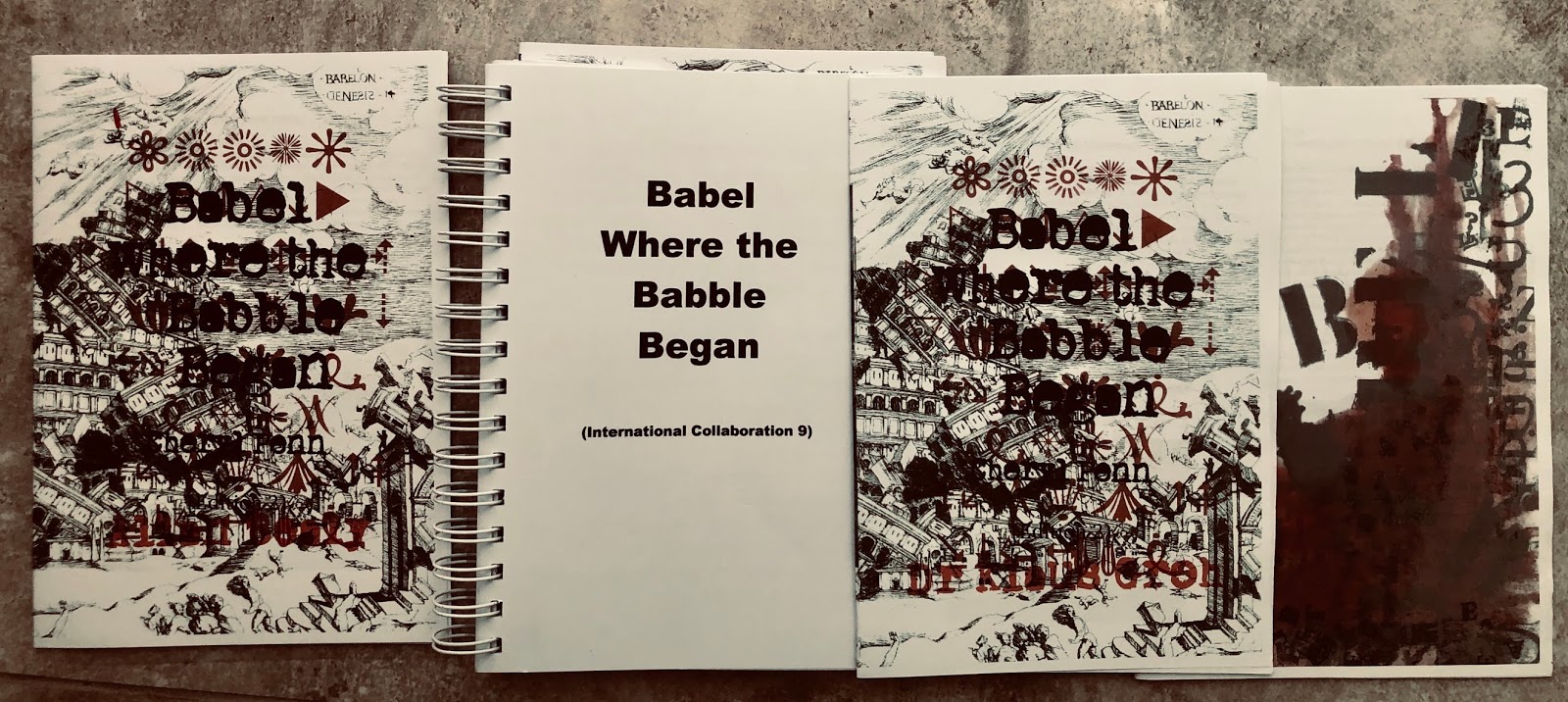
Babel Collaborations

There have been about 17 participants in this collaboration so far, with just 3 sets outstanding, but mostly on their way.  They have been collated into three pocket books for the New Alexandrian Library and one set has gone to Japan for exhibition in December.  Each participant received 5 other altered copies of Babel.

Here are some of the USA collaborations received:

                                                    Cheryl Penn/John Bennett (USA)


Cheryl Penn/Allan Bealy (USA)


Cheryl Penn/Rosaire Appel (USA)


Cheryl Penn/Mark Sonnenfeld (USA)


Cheryl Penn/Alicia Starr (USA)


Thursday, 10 January 2019

Babel Edition 9
Original (Cheryl Penn)
# 1 Cheryl Penn (South Africa) and David Stone. Edition of 20.

I have not done a large collaboration for quite a quite a while, so I’m really looking forward to seeing how it pans out.  The idea is that I send participants 2 copies of a chapbook titled Babel, one to keep and one to alter.  The original altered copy is sent back to me and I make an edition of 7.  I keep one, two get sent back to the artist, one bound, one unbound for them to copy and reproduce if they wish.  They also receive 5 other chapbooks from other artists who have followed this same process. The first one I have tackled is with the poet David Stone (USA). David exchanged words via email. As a wordsmith David is immediately responsive to titles and images and his poetry is its usual enigmatic, apparently disconnected phrases and words which, once read somehow make total sense. They also evoke strong mental imagery. 

“bracketed barriers enclosed the summation of
orders
toes tagged
silence lost” 

As I had a bit of time on my hands, the copies I made have numerous hand painted elements, but I‘m not sure if this practice will remain, although 7 copies is quite manageable. There are an extra few copies for him and I to both distribute. I will be using this small volume as an enticement - (I hope!) for others to join in the collaboration. 


Original chapbook which was altered


Tuesday, 18 December 2018

Asemic 16 Collaboration

Its just as well I started searching for this book as I was reminded that firstly it had never entered The New Alexandrian Library documentation and secondly, I'd forgotten how amazing it was, so it was a wonderful surprise to see it again after so long.  All the introductions from De Villo Sloan are an important part of the documentation of this book.  They will also form part of the 'article' - I hesitate to call it that yet as it's still embryonic (but long!).
5 sets of artists in groups of 16 participated in this international call, hosted by IUOMA.
This volume comprised 3 collaborations. I have included De Villo's first introduction here as he said everything worth saying! He was an excellent co-host I might add. I remember that we had so many volumes as there were so many people wanting to participate - an exciting experience!  Books like these make me loathe to just surrender my library to a university institution!!!  Various artists around the world bound their handsome volumes too, and I know they went on a variety of exhibitions around the world.

Asemics 16 - Introduction to Edition 1 
De Villo Sloan 
The global mail-art network, which evolved from art practices in the United States and Europe in the 1960s, has for decades served as a conduit for visual-verbal forms. Mail-art’s close ties to the Fluxus movement have unquestionably strengthened this connection. Vital work long-nurtured by the network includes concrete poetry, visual poetry, haptic and object poetry as well as the fairly esoteric yet endlessly fascinating practice of asemic writing.
 In May 2011, South African artist Cheryl Penn launched an ambitious collaborative mail-art book project encompassing four editions; this is the first. I have been greatly honored to coordinate the project with her. The International Union of Mail-Artists (IUOMA), founded by Ruud Janssen of the Netherlands, has served as an ideal headquarters in cyberspace for an effort that involves many artists from around the globe.
 Through Asemics 16, Penn has sought to chronicle the work of contemporary asemic writers in the mail-art network, to encourage other artists to explore asemic writing, and to push the boundaries of current practice. Thus you will find in this edition work by asemic writers who are well-known in the field. You will also find artists who work in collage, painting, photography, and conceptual art, among others. By crossing traditional boundaries they have produced extraordinarily innovative contributions.
 The realm of asemic writing includes the invention of imaginary languages with corresponding symbols and systems for their arrangement. Asemic writing suggests a language, might at times reveal traces of known language, but ultimately cannot be read as any existing language or extinct language that has been recorded. Through the absence, discontinuity or disruption of conventional signification, new meanings and realizations are made possible. Visual and material elements of written language are brought to the forefront.
 Depending upon the approach taken by the individual artists in Asemics 16 – Edition 1, asemic writing can be wondrously simple or intriguingly complex. Some of the artists found inspiration in the scrawling of young children seeking to mimic the writing they have seen but not yet mastered; some delved into personal symbol systems they first created as children themselves.
 Other contributors have made asemic signs and syntax from found material and asemic-suggestive shapes in nature. Some have delved into prehistoric glyphs and ancient texts; others have drawn inspiration from street art. The result in Asemics 16 is a vast, global dialog of human expression not constrained by time, space or language.
 Asemic writing is also a medium that can be illuminated and explained through advanced cultural theory in fields including semiotics and linguistics. It addresses deeply philosophical questions involving indeterminacy, incomprehensibility, and meta-language. This edition with all its visual richness brings us together in the shared experience of being human and our relationship to the world.

 De Villo Sloan
August 8, 2011
Auburn, New York, USA  

On this spread are pages by Rosa Gravino (Argentina), Frieder Speck (Germany) and Guido Vermeulen (Belguim), who was a great loss to the Mail Art Community. 

Monday, 10 December 2018

Toxic Bachelors

Toxic Bachelors
Unique altered book, mixed media, including collage, altered text, inserted letters, nuts/bolts, glass case. 

So this is an oldie, but a goodie. I heaved it out from under the building rubble - not the bricks and mortar rubble, the STUFF rubble. I’m SO in two minds as to what to do with my collection of books. I must have, altogether, over 1000 artists books, in the main, handmade. I really DO need a reading room. Toxic Bachelors was part of my altered books stage. It was made in 2008 - its hard to believe its ten years old. The book I chose to alter was Toxic Bachelorsby Daniel Steele. The story in the main concentrated on 3 successful, good looking blah blah blah men who gave up their bachelor status for love, of the novel kind. The original text of the novel was painted out and words appropriate to a more sinister meaning were kept. For example, the words remaining on the page dealing with Alegre Patrice, the sadistic, deluded Frenchman who was convicted of 115 murder/rapes are:…an unforgettable night…and for one night at least she had forgotten everything she wanted… Quite spooky and thoroughly unpleasant when one removes words and phrases from their original context. There’s a lesson to be learned there for sure.  Within the pages I collected and inserted letters from women who have had toxic men in their lives. It’s not a pleasant read. 


Friday, 13 July 2018

Making Poetic the Visual and Visual the Poetic

Making Poetic the Visual and Visual the Poetic
This book came about as a result of Course 2 in the MoJo Modules - Accessing Instinctual Creativity. The five classes were:
What is Poetry and this included a skid through the history of poetry and its various forms. Using asemic writing, we then wrote a limerick, a quatern, a sonnet and free verse poetry - all of which would form part of a chapbook which was published in an edition of 5 at the end of the course.


Free Form word formation and association was the task in session 2. It was collaborative in that we all worked on 24 different sets of pages.


These will form part of the next edition of Mail Art Makes the World a Town (See An Encyclopedia of Everything - http://an-encyclopedia-of-everything.blogspot.com )


 Visual Representation of Words and Language (including Poetry) from Ancient times to today was the next section we tackled, including the skid, the slide…(you have to book for the course to find out about that one)!  And so we went on, until the final class where we assembled the artists books.  Remember - this is not about being a necessarily a poet - but everyone was surprised, how given the chance, words make their presence felt.  The course is about accessing creativity which resides inside ALL of us and this module used the poetics and visual-ness of words as medium.

The final hard covered book consisted of 4 chapbooks from the participants and a book of visual poetry by John Bennett (USA) who a while ago had sent me extra copies of one of his publications, in an accordion format with pamphlet stitch pockets.